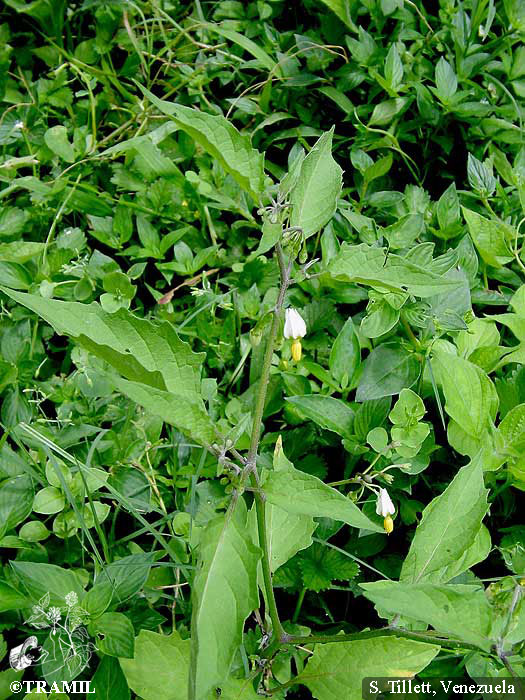


(In territories with significant traditional TRAMIL use)
Guatemala:
- hierbamora
- macuy
- quilete
Venezuela:
- yerba mora
ripe leaf, cut at the end of or after fruition, decoction, applied in vaginal washes1
According to the information available:
The use for shingles (herpes zoster) and vaginal discharge is classified as REC based on the significant traditional use documented in the TRAMIL surveys, the toxicity studies and the scientific information published.
All topical application must follow strict hygiene measures that prevent contamination or additional infection.
If deterioration is observed in the patient and the symptoms of shingles (herpes zoster) persist for more than 15 days or the vaginal discharge for more than 7 days, seek medical attention.
Not for use during pregnancy, breastfeeding or in children under 10 years.
The fresh young plant and the ripe fruit are foods of relatively widespread human consumption15-17.
For shingles (herpes zoster):
Wash 1 bunch (30-60 grams) of aerial parts adequately with boiled water and crush. Apply locally in sufficient amounts to cover the affected area 2 times a day18-19.
Or chop up 1 bunch (30-50 grams) of leaves and fruits and add them to a litre of boiled water, leave them to stand for 12 hours and bathe or wash the affected area twice a day.
For vaginal discharge:
prepare a decoction with 1 bunch of leaves (30-60 grams) in 4 cups (1 litre) of water.
Boil for 10 minutes in a covered vessel, allow to cool, strain (filter) and apply in sitz baths and douches 3 times a day18-19.
Preparations must never be stored for more than 24 hours, even if refrigerated.
1 GIRON L, 1988
Encuesta TRAMIL (Costa atlántica). Centro Mesoamericano de Tecnología CEMAT, Guatemala, Guatemala.
2 DELENS M, 1990
Encuesta TRAMIL en Barlovento, Edo. Miranda de Venezuela. Centro al Servicio de la Acción Popular CESAP, Caracas, Venezuela.
3 GOMEZ H, 2003
Estudio fitoquímico de algunas plantas promisorias del Caribe colombiano. Informe TRAMIL. Grupo de Productos Naturales, Facultad de Ciencias Químicas y Farmacéuticas. Universidad de Cartagena, Cartagena de Indias, Colombia.
4 MOREJON Z, VICTORIA MC, MORON F, MENDEZ G, FUENTES V, 2006
Tamizaje fitoquímico de la un extracto fluido de partes aéreas secas de Solanum americanum . Informe TRAMIL. Laboratorio Central de Farmacología, Facultad de Ciencias Médicas “Dr. Salvador Allende”, La Habana, Cuba.
5 ALDANA MV, LIMA CN, 1999
Isolation and characterization of a glycoside from fluid extracts of Solanum americanum Mill. Afinidad 56(484):393-396.
6 CACERES A, ALVAREZ AV, OVANDO AE, SAMAYOA B, 1991
Plants used in Guatemala for the treatment of respiratory diseases. 1. Screening of 68 plants against Gram-positive bacteria. J Ethnopharmacol 31(2):193-208.
7 VICTORIA AE, 1980
Investigación farmacológica de la acción hipoglucemiante de la hoja de Solanum nigrescens Mart & Gal. (macuy, quilete o hierba mora). Tesis Guatemala, Facultad de CCUU y Farmacia, USAC, Guatemala, Guatemala.
8 COONEY G, BUCKLEY H, BRICKUS T, CACERES A, 1991
Fungicidal activity of Solanum plant extract from Guatemala, C.A. Abstracts CD52. Pharmacy Word Cong, Washington DC, USA.
9 CACERES A, LOPEZ BR, GIRON MA, LOGEMANN H, 1991
Plants used in Guatemala for the treatment of dermatophytic infections. 1. Screening for antimycotic activity of 44 plant extracts. J Ethnopharmacol 31(3):263-276.
10 SANCHEZ LM, BULNES C, PEREZ P, RODRIGUEZ A, NOA M, GINORIO C, GOMEZ BC, 2003
Actividad antibacteriana, cicatrizante y útero-estimulante de Solanum americanum Miller. Actualidades Biológicas 25(78):71-78.
11 LOPEZ M, MARTINEZ MJ, MOREJON Z, BOUCOURT E, FERRADA C, FUENTES V, MORON F, 2005
Irritabilidad dérmica primaria de una decocción de hoja seca Solanum americanum Mill. Informe TRAMIL. Laboratorio Central de Farmacología, Facultad de Medicina “Dr. Salvador Allende”, La Habana, Cuba.
12 PAZOS L, COTO T, CAIZA F, 2009 Irritación dérmica, piel sana en conejos, porción de hoja fresca de Solanum americanum. Informe TRAMIL. Laboratorio de Ensayos Biológicos, LEBi, Universidad de Costa Rica, San Pedro, Costa Rica.
13 MARTINEZ MJ, LOPEZ M, MOREJON Z, BOUCOURT E, FUENTES V, MORON F, 2005
Irritabilidad vaginal de decocción de hoja seca de Solanum americanum. Informe TRAMIL. Laboratorio Central de Farmacología, Facultad de Ciencias Médicas “Dr. Salvador Allende”, La Habana, Cuba.
14 MARTINEZ MJ, LOPEZ M, MOREJON Z, BOUCOURT E, FUENTES V, MORON F, 2005
Clases tóxicas agudas oral de decocción de hoja seca, de tallo seco y de frutos verdes secos de Solanum americanum. Informe TRAMIL. Laboratorio Central de Farmacología, Facultad de Ciencias Médicas "Dr. Salvador Allende", La Habana, Cuba.
15 ALTSCHUL S, 1973
Drugs and food from little-known plants: Notes in Harvard University Herbaria. Cambridge, USA: Harvard Univ Press.
16 MORTON J, 1977
Some folk-remedy plants of Central American markets. Quart J Crude Drug Res 15:165-192.
17 SOUZA-NOVELO N, 1950
Plantas alimenticias y plantas de condimento que viven en Yucatán. Mérida, México: Inst.Tecn.Agrícola Henequenero.
18 ALBORNOZ A, 1993
Medicina Tradicional Herbaria. Caracas Venezuela: Editorial Instituto Farmacoterápico Latino S.A. p132.
19 CACERES A, 1996
Plantas de uso medicinal en Guatemala. Ciudad de Guatemala, Guatemala: Editorial Universitaria. p315.