

Vernacular names
(In territories with significant traditional TRAMIL use)
Haiti:
- datira
Geographical distribution
Widely distributed in the tropics and subtropics of the Old and New World.
Botanical description
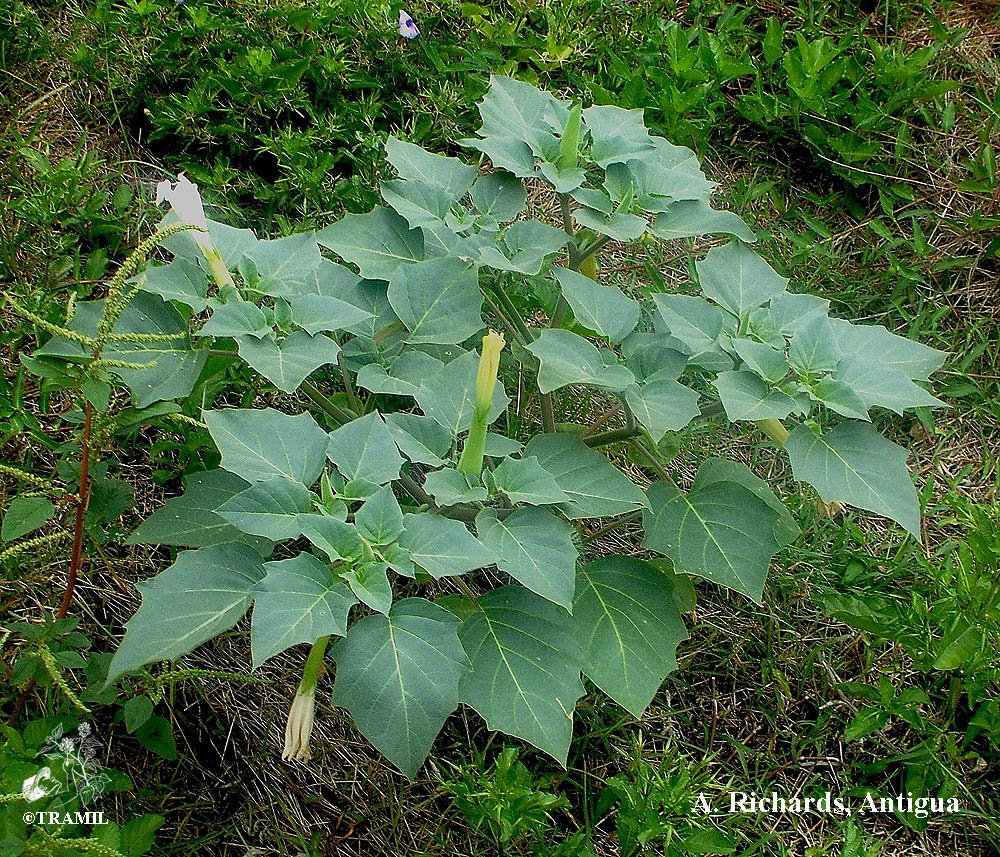
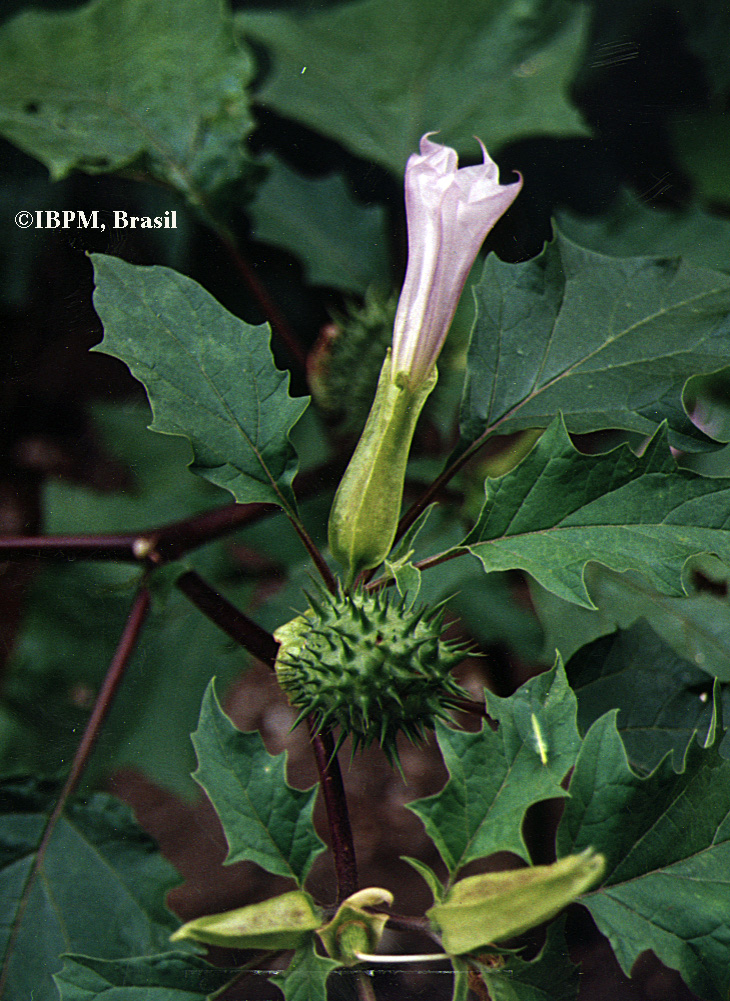
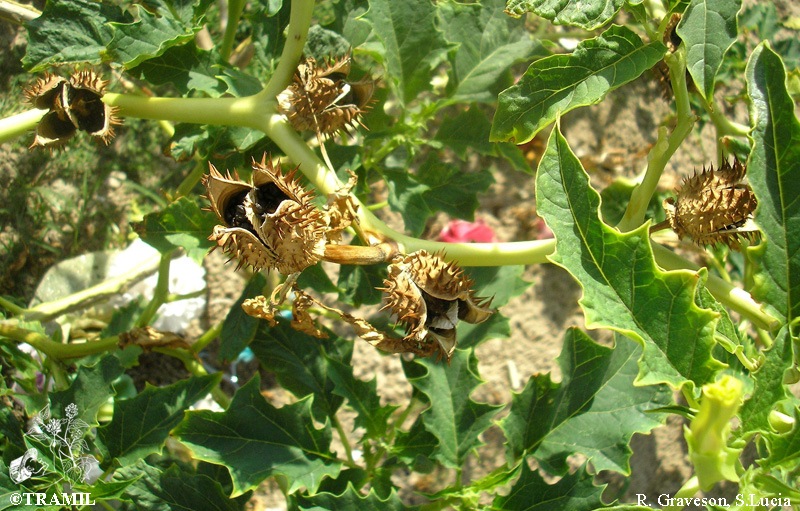
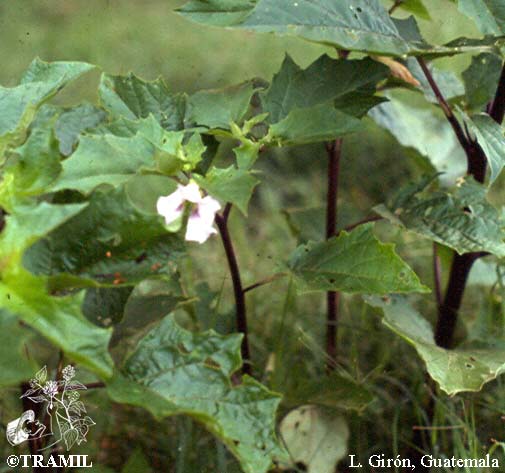
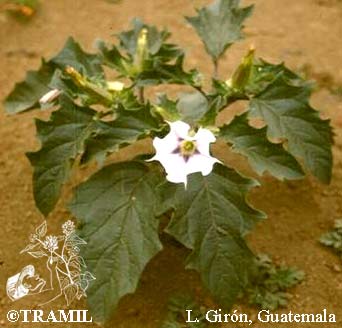
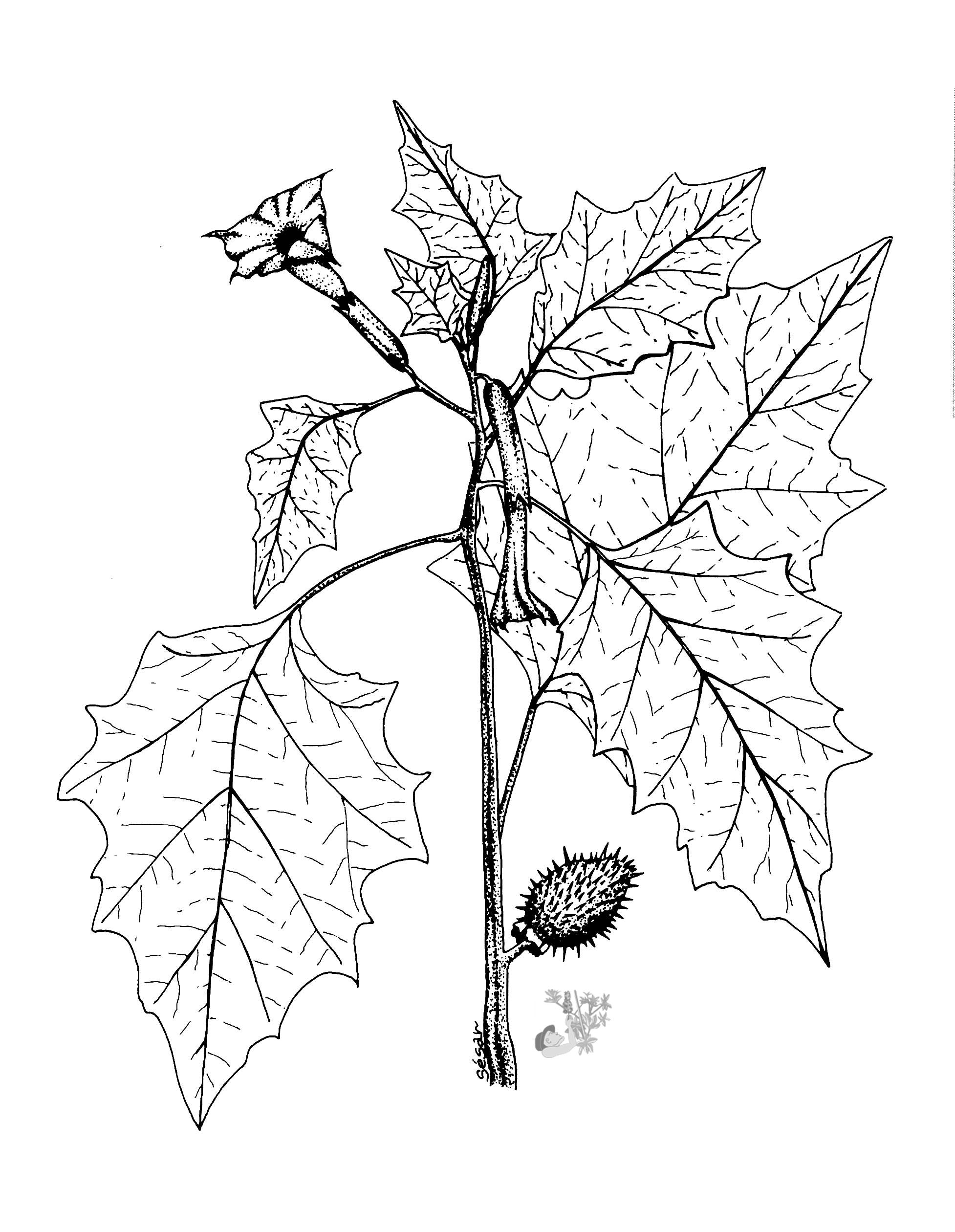
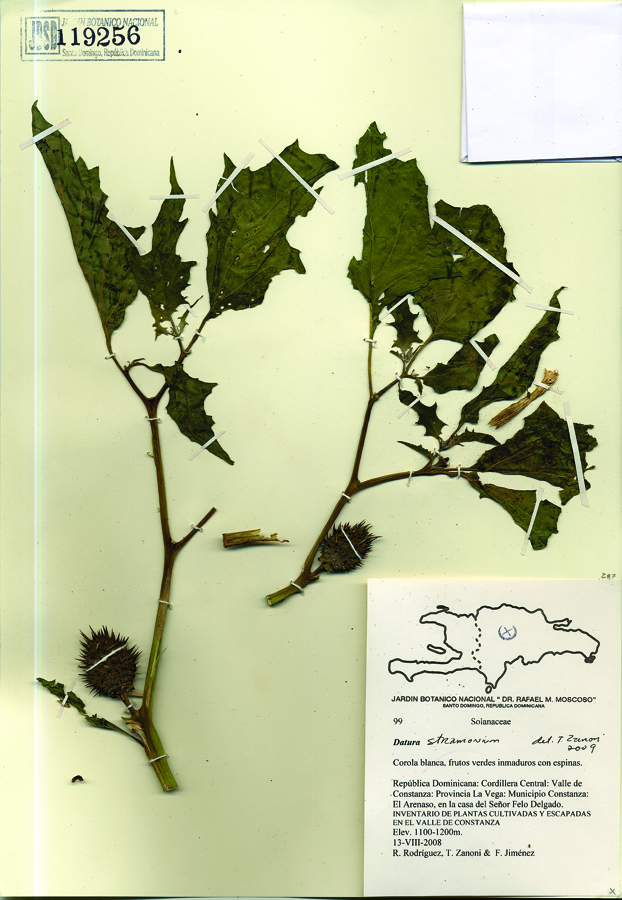
Herbaceous annual, up to 1 m high, glabrous or pubescent in the young parts. Alternate leaves, oval, acuminate, somewhat dentate, up to 20 cm. Flowers erect, 6 to 10 cm; calyx tubular, almost cylindrical, narrow, 3 to 4 cm, with sharp teeth; white corolla, lobes 5 with filiform appendages. Capsule erect, dehiscent, covered with long, sharp spines; seeds reniform.
Voucher(s)
Jiménez,686,JBSD



Pharmacopoeia
Ed.3References
1 WENIGER B, ROUZIER M, 1986
Enquête TRAMIL. Service Oecuménique d'Entraide SOE, Port au Prince, Haïti.
2 ALAMI RR, CHRISTENSEN BV, BEAL JL, 1955
A note on the alkaloidal ratios in certain species of Datura. J Am Pharm Assoc Sci Ed 44:710-711.
3 HEGNAUER R, 1973
Chemotaxonomy der Pflanzen. Basel, Schweiz: Birkhauser Verlag. 6:882.
4 SONANINI D, RZADKOWSKA-BODALSKA H, STEINEGGER E, 1970
Solanaceae flavones. 7. Flavonol glycosides from folium stramonii. Pharm Acta Helv 45(2):153-156.
5 TURSUNOVA R, MASLENNIKOVA V, ABUBAKIROV N, 1976
Withanolides of Datura stramonium. Khim Prir Soedin 12:670A.
6 PATE D, AVERETT J, 1986
Flavonoids of datura. Biochem Syst Eco 14(6):647-649.
7 SCHMITZ BOURGEOIS M, AMIRI I, REINBOLT J, BOULANGER Y, UNGERER A, 1988
Isolation and structure of a pseudopeptide gamma-L-glutamyl-L-aspartic acid from Datura stramonium that impairs learning retention in mice. Biochimie 70(9):1179-1184.
8 PINKAS M, BEZANGER-BEAUQUESNE L, 1986
Les plantes dans la thérapeutique moderne. Paris, France: 2 éd. Ed. Maloine.
9 VINCENT D, LESOBRE R, KAUFMAN E, 1965
An antiasthmatic smoke as an anticholinergic and antihistamic effect. Therapie 20(4):931-952.
10 ITOKAWA H, MIHASHI S, WATANABE K, NATSUMOTO H, HAMANAKA T, 1983
Studies on the constituents of crude drugs having inhibitory activity against contraction of the ileum caused by histamine or barium chloride (1) screening test for the activity of commercially available crude drugs and the related plant materials. Shoyakugaku Zasshi 37(3):223-228.
11 FORNO JR FJ, TERRY RA 1998
Accidental ingestion of jimsonweed by an adolescent. J Am Osteopath Assoc 98(9):502-565.
12 UNGERER A, SCHMITZ-BOURGEOIS M, MELAN C, BOULANGER Y, REINBOLT J, AMIRI I, BARRY J, 1988
Gamma-L-glutamyl-L-aspartate induces specific deficits in long term memory and inhibits [3H]glutamate binding. Brain Res 446(2):205-211.
13 Hardman JG, Limbird LE, Molinoff PB, Eds., 1996
Goodman & Gilman las bases farmacológicas de la terapéutica. 9a ed. México: McGraw-Hill Interamericana: p158-163.
14 PARRA AL, YHEBRA RS, SARDINAS IG, BUELA LI, 2001
Comparative study of the assay of Artemia salina L. and the estimate of the medium lethal dose (LD50 value) in mice, to determine oral acute toxicity of plant extracts. Phytomedicine 8(5):395-400.
15 KEELER RF, 1981
Absence of arthrogryposis in newborn Hampshire pigs from sows ingesting toxic levels of jimsonweed during gestation. Vet Hum Toxicol 23(6):413-415.
16 GOTO M, NOGUCHI T, WATANABE T, ISHIKAWA I, KOMATSU M, ARAMAKI Y, 1957
Uterus-contracting ingredients in plants. Takeda Kenkyusho Nempo 16:21.
17 HARVEY RB, LARSO AH, LANDON RH, BOYD WL, ERICKSON LC, 1945
Weeds poisonous to livestock. Bull Minnesota Agr Exp Sta 388:1.
18 FERNANDO R, FERNANDO DN, 1990
Poisoning with plants and mushrooms in Sri Lanka: a retrospective hospital based study. Vet Hum Toxicol 32(6):579-581.
19 BALLANTYNE A, LIPPIETT P, PARK J, 1976
Herbal cigarettes for kicks. Brit Med J 2:1539.
20 PEREIRA CAL, NISHIOKA SDA, 1994
Poisoning by the use of Datura leaves in a homemade toothpaste. J Toxicol Clin Toxicol 32(3):329-331.
21 GOWANLOCH JN, BROWN CA, 1943
Poisonous snakes, plants and black widow spider of Louisiana. New Orleans, USA: Dept. Conservation, Book.
22 HARRISON EA, MORGAN DH, 1976
Abuse of herbal cigarettes containing stramonium. Brit Med J 2:1195.
23 ODERDA GM, 1975
Jimson weed. J Am Med Assoc 232:597.
24 SCHMIDT A, 1943
Poisoning with stinging nettle tea. Pharm Zentralhalle Dtschl 84:238-239.
25 LAMENS D, DE HERT S, VERMEYEN K, 1994
Tea of thornapple leaves, a rare cause of atropine intoxication. Acta Anaesth Belg 45(2):55-57.
26 SIEGEL RK, 1976
Herbal intoxication. Psychoactive effects from herbal cigarettes, tea, and capsules. J Am Med Assoc 236(5):473-476.
27 GUHAROY SR, BARAJAS M, 1991
Atropine intoxication from the ingestion and smoking of jimson weed (Datura stramonium). Vet Hum Toxicol 33(6):588-589.
28 PARIS R, MOYSE H, 1981
Précis de matière médicale. Paris, France: Ed. Maloine.
29 CHONKEL A, 1985
A propos de quelques graines toxiques existant à la Guadeloupe (Thèse Pharmacie). Faculté de Pharmacie, Montpellier, France.
30 HARDIN J, ARENA J, 1974
Human poisoning from native and cultivated plants. 2nd ed. Durham, USA: Duke University Press.
31 TAH S, MAHDI A, 1984
Datura intoxication in Riyadh. Soc Trop Med Hyg 78(1):134-135.
Warnings
According to the information available:
The use of the dried flowers and leaves for asthma and dyspnea attacks is classified as TOXIC (TOX).
Given the toxicity of the aerial parts of this plant, its use is discouraged, regardless of the therapeutic qualities it offers.
In the event of poisoning by ingestion or inhalation of the aerial parts, seek medical assistance.